Skip to content
5-Axis CNC Machining

5-Axis CNC Machining

Simultaneous five-axis machining for impellers, blades, sculpted surfaces and complex parts that cannot be reached or finished accurately in three axes.

Tolerance
±0.01 mm typical on critical features
Best fit
Sculpted surfaces, undercuts, impellers, ports and deep cavities
Surface finish
Short cutters held at the ideal angle give better finishes on deep features
Lead time
From 7 working days

How we hold this quality

Undercut geometry

Tilting the tool to the part lets us machine features that a three-axis machine simply cannot reach, including undercuts and angled ports.

Shorter, stiffer tooling

Keeping the cutter short and angled reduces deflection, which improves both surface finish and dimensional accuracy in deep cavities.

Continuous toolpaths

Simultaneous motion blends surfaces in one pass, avoiding the witness marks and hand polishing that come from stopping and restarting around a part.

Complex geometry in fewer setups

Five-axis machining frequently replaces three or more operations, which shortens lead time and protects the part's datums.

Five-axis machining exists to solve problems that other processes cannot: geometry that cannot be reached, surfaces that have to blend continuously, and deep features where a three-axis setup would need an impractically long cutter.

What we machine

Impellers and rotors, turbine and compressor components, manifolds and ported housings, aerospace and UAV structural brackets, medical instrument bodies, and sculpted consumer product housings where the cosmetic surface has to flow without witness lines.

Planning a five-axis job

The work is decided in CAM before a machine is reserved: toolpaths are collision-checked, the fixture is modelled, and the datum strategy is fixed. That planning step is what allows the part to be machined in one or two setups instead of five, and it is the reason five-axis jobs are quoted from the model rather than from a rough size estimate.

Verification

Sculpted surfaces are verified on a CMM against the supplied model. Where the part has functional features, we measure those features directly and report them, rather than relying on the surface scan alone.

Process & part gallery

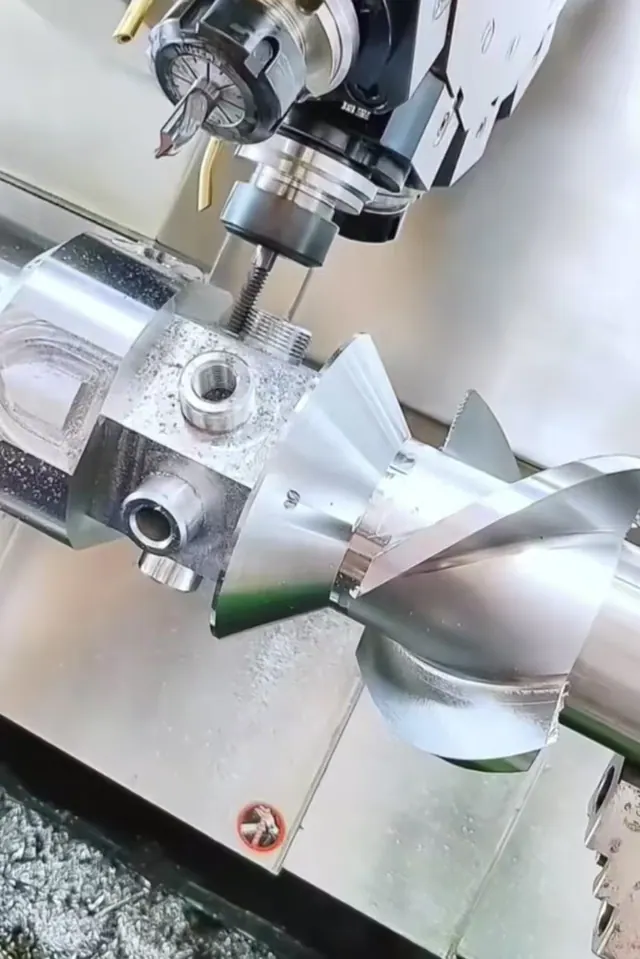
Five-axis machined impeller with twisted blades
Large machined housing with multi-directional features
Ported manifold machined from several directions

How it works

From drawing to delivered part

  1. 1

    Send drawings

    Upload STEP, IGES, DXF or PDF files with material, quantity and finish.

  2. 2

    Engineering review

    We check manufacturability, tolerances and finish for this process.

  3. 3

    Quote and approve

    You receive unit price, lead time and any design questions in writing.

  4. 4

    Produce & inspect

    Manufacturing runs against an agreed inspection plan.

  5. 5

    Ship and support

    Parts are packed, documented and shipped, with support for revisions.

FAQ

5-Axis CNC Machining — frequently asked questions

Which parts actually need five-axis machining?

Impellers and blades, parts with angled faces or ports that cannot be reached from a normal direction, deep cavities where a short cutter must stay at an angle, and prototypes with sculpted surfaces. If four axes can reach the geometry, we will quote the cheaper process.

Can you machine an impeller from my STEP file?

Yes. Please send a solid model with the blade geometry as designed, and note whether the part is for a functional test or for appearance — it affects how much smoothing and hand finishing we plan.

Is five-axis machining more accurate than three-axis?

Not automatically — accuracy still comes from the fixture and the plan. The advantage is that five-axis setups remove operations and let the tool approach the part at a better angle, which improves results on complex geometry.

Start a project

Request a 5-axis cnc machining quotation

Upload your CAD files with the material, quantity and finish. Our engineers will review the drawing and reply with pricing and lead time.