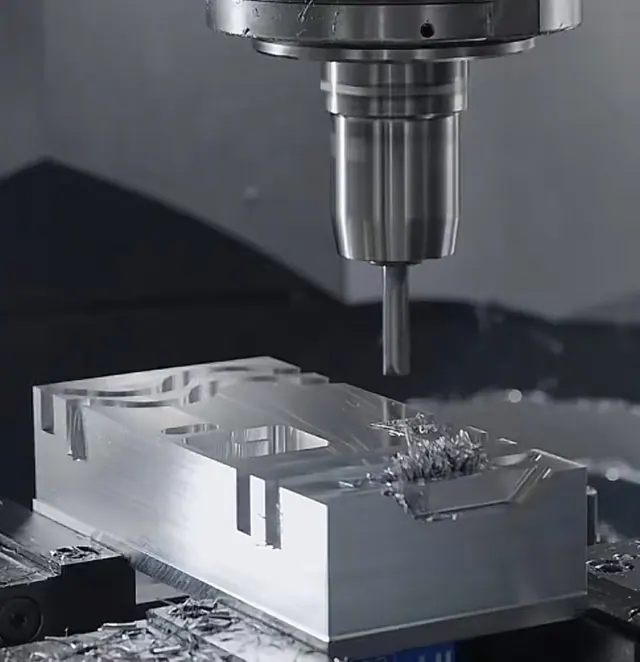
Milling covers most of the custom parts we make: housings and covers that need flat, parallel faces and accurate bolt patterns; brackets and plates with pockets and slots; and complex three-dimensional profiles that need to be cut from more than one direction.
How the part is planned
Before cutting, we decide the machining sequence, how the part will be held in each operation, which faces become the datum, and how the critical features will be measured. That plan is what allows a thin-walled housing to be machined without chatter marks and a bolt pattern to line up with the mating part.
Materials and finishes
Aluminium is the most common choice for machined parts because it machines quickly and anodizes well. Stainless steel, carbon steel and titanium are used where strength, corrosion resistance or temperature resistance matter more than cycle time, and engineering plastics cover insulating, low-friction and RF-transparent applications.
See 4-axis machining and 5-axis machining if the part needs machining from several directions without losing the datum, or CNC turning for rotational features.